

A WordPress user profile plugin gives each member a page of their own on the front of your site, with their name, photo and details, plus an account page where they edit it. WordPress doesn’t have one out of the box: every user has a profile, but it lives in the dashboard where only they and your admins see it, and the only public page is an author archive listing their posts. This guide compares seven plugins that fix that, including our own, WP User Manager, and says where each one is the better pick.
We make WP User Manager, so read our section with that in mind. We’ve tried to be fair to the others, and the install counts, ratings and prices below come from wordpress.org and each plugin’s own site in October 2026.
What a user profile plugin should do
Most of these plugins also handle registration and login. For profiles, these are the things that separate them:
- A front-end profile page that looks like part of your site, not the dashboard, with an avatar and ideally a cover image.
- An account page where members edit their own details, change their password and upload a photo, without going near wp-admin.
- Custom fields, so a profile can show what matters on your site: a job title, a location, a portfolio link.
- Privacy controls: who can see profiles (guests, members, nobody), and whether members can hide their own.
- A member directory, searchable, so members can find each other.
- Something to show: tabs for the member’s posts and comments, or activity from other plugins.
Beyond that it’s a choice between a focused plugin and a whole social network. If you want activity feeds, friends and private messages, look at the bigger plugins. If you want clean profiles and a directory without the weight, look at the lighter ones.
WordPress user profile plugins at a glance
| Plugin | Active installs | Rating | Free member directory | Paid plans from |
|---|---|---|---|---|
| WP User Manager | 10,000+ | 4.7 | Yes | $149 a year |
| Ultimate Member | 200,000+ | 4.4 | Yes | $276 a year |
| ProfilePress | 100,000+ | 3.1 | Yes | $129 a year |
| Profile Builder | 40,000+ | 4.7 | No (paid) | €99 a year |
| UsersWP | 20,000+ | 4.7 | Yes | $99 for 4 months |
| User Registration & Membership | 50,000+ | 4.8 | No (paid) | $99 a year |
| ProfileGrid | 5,000+ | 4.6 | Yes | $79 one time |
Installs and ratings are from wordpress.org; prices are each vendor’s cheapest paid plan, for one site unless noted.
1. WP User Manager
WP User Manager is ours. We built it for sites that need good-looking profiles, registration, login and a member directory without turning into a social network.
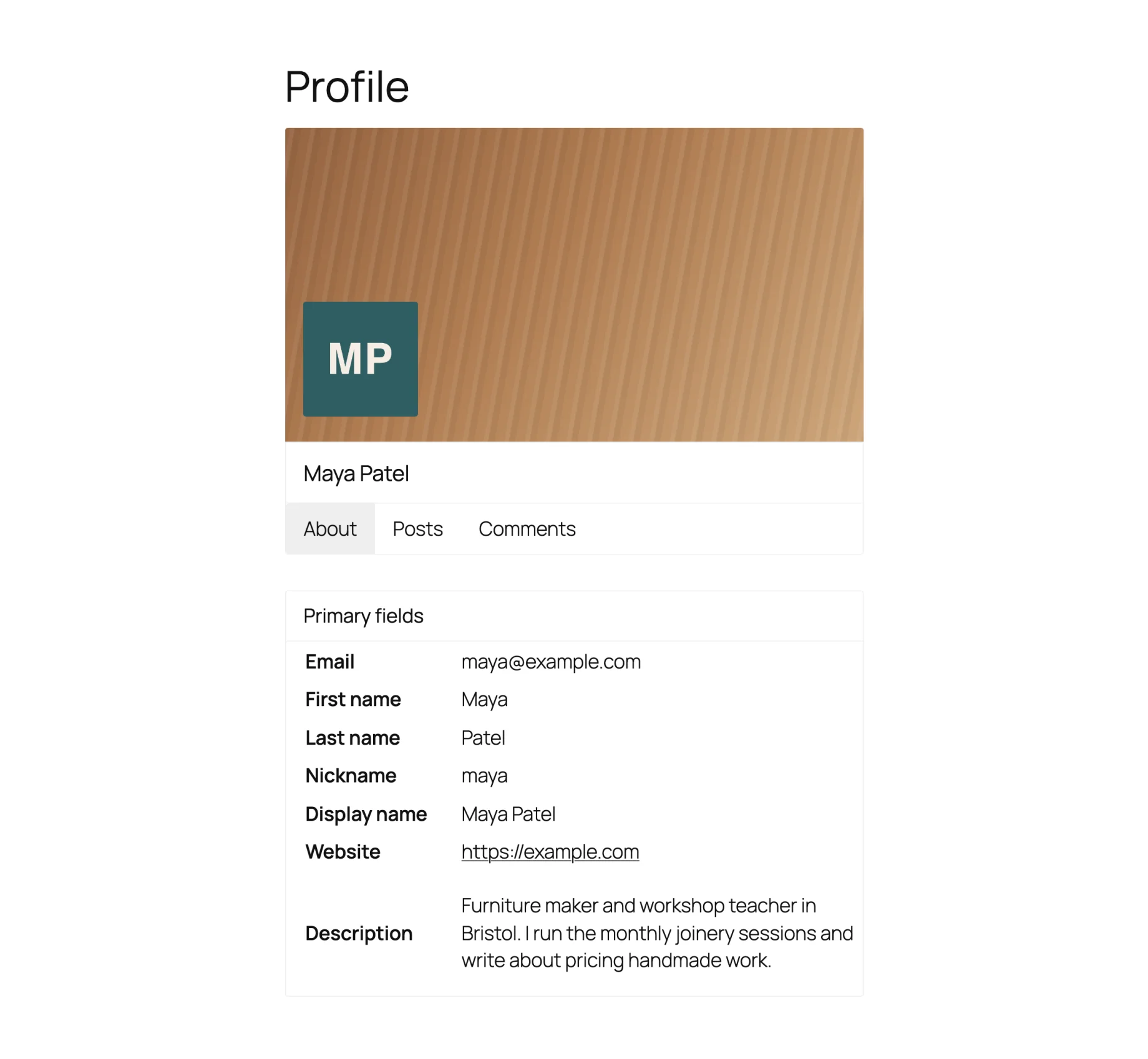
What the free plugin gives you:
- Front-end user profiles with a cover image, avatar and tabs. The About tab shows the member’s details; Posts and Comments tabs list what they’ve written, and you can turn either off.
- Custom avatars and cover images that members upload from their account page, so they don’t need a Gravatar.
- Privacy settings for whether guests and members can view profiles, plus an option that gives each member a Privacy tab to hide their own.
- Member directories with search, sorting, a per-page setting and a choice of which roles to list. You can have as many as you like, each added to a page with a shortcode.
- An account page, a roles editor, and front-end registration, login and password reset forms.
Adding your own profile fields needs the paid Custom Fields addon, which brings field groups, a drag-and-drop editor and over 20 field types, from text and dropdowns to file uploads and repeaters. Other addons add to profiles too, such as Groups, which puts a member’s groups on their profile.
Where others are stronger: Ultimate Member has a much bigger extension library and community, and if you want activity walls, followers or private messaging, ProfileGrid, BuddyPress and Ultimate Member’s extensions do that and we don’t.

Get Started with the Best WordPress Membership Plugin Today
Connect, Manage and Build your Membership Site
Pricing: the core plugin is free. Addon bundles start at $149 a year for one site; Custom Fields is in the Plus bundle and up, from $199 a year for five sites. See pricing.
2. Ultimate Member
Ultimate Member is the best-known plugin here, with over 200,000 active installs. The free plugin covers front-end profiles, custom form fields with conditional logic, member directories, profile tabs, and posts and comments on profiles.
Its strength is breadth. Paid extensions add groups, a social activity wall, followers, user photos, a map in the member directory, and profile completeness, which nudges members to fill in their profile. If you want your site to feel like a social network, it gets you further than most.
The cost is weight and price. The Standard plan, with 21 extensions, is $276 a year for one site, and a lot of settings come with all that. If you’re weighing it up, we compare the two side by side in WP User Manager vs Ultimate Member, and our Ultimate Member alternatives roundup covers the other options.
3. ProfilePress
ProfilePress started as a profile and login plugin and has become a membership and payments plugin. The free version includes user profiles and member directories with a drag-and-drop builder and ready-made templates, and an account page where members manage their details and see their recent logins.
Most of its development now goes into selling memberships and digital products: Stripe, PayPal and other payment gateways, subscriptions, and integrations with WooCommerce and LMS plugins. That suits a site that charges for access. Two things to know: the free version adds a 2% fee to Stripe payments until you buy a plan, and its wordpress.org rating (3.1 from over 900 reviews) is the lowest here.
Pricing: from $129 a year for one site.
4. Profile Builder
Profile Builder by Cozmoslabs focuses on forms: front-end registration, login and edit profile forms, with an avatar upload field and drag-and-drop field ordering. You add them with shortcodes or blocks, such as [wppb-edit-profile] for the front-end profile editor.
It’s well rated and well maintained, but the free version is about editing profiles rather than showing them. The user listing that powers member directories and public profiles is in the Pro plan, as are multiple edit profile forms for different roles.
Pricing: Basic is €99 a year for one site and includes unlimited custom fields; the user listing needs Pro, €169 a year for three sites.
5. UsersWP
UsersWP bills itself as the lightweight option, and it was built as a simpler alternative to the bigger plugins. The free version includes a drag-and-drop form builder with custom fields, a user profile with a cover image, avatar and tabs, and a users directory.
Its standout is page builder support. You can lay out the profile and directory templates in Elementor, Divi, Oxygen, Beaver Builder or the block editor, moving the avatar, fields and tabs wherever you like. If your site is built in a page builder, that’s a real advantage. Premium add-ons connect it to WooCommerce, bbPress and WP Job Manager, and add profile progress and activity.
Pricing: a membership with every add-on and unlimited sites is $99 for four months or $199 a year.
6. User Registration & Membership
User Registration & Membership, from WPEverest, has the highest rating here. As the name says, it has grown from a registration form builder into a membership plugin: membership plans, content restriction and payment gateways are all in the free version, alongside a drag-and-drop form builder with over 60 field types and conditional logic.
Profiles are part of it rather than the focus. Members get a My Account page, but the member directory with search filters is in the paid plans.
Pricing: Personal, which includes the member directory, is $99 a year for one site.
7. ProfileGrid
ProfileGrid is built around groups. Each group works as a profile type with its own fields, its own sign-up flow and its own managers, and members can join several. On top of that the free version has private messaging, a friends system and profile pages that pull in content from WooCommerce and bbPress.
That makes it a strong fit for communities with distinct member types: a club with players, coaches and parents, or a network of local chapters. If you only need one kind of profile, it’s more than you need.
Pricing: Premium is $79 as a one-time payment with a year of updates for one site; Premium+ is $139 with lifetime updates on unlimited sites.
What about BuddyPress?
BuddyPress isn’t a profile plugin so much as a social network: activity streams, friends, private messages and groups, with extended profile fields. It’s free and has been around for years. Choose it if the social features are the point of your site. If you mainly need profiles and a directory, it’s a lot to take on. We cover pairing the two in our guide to a membership plugin for BuddyPress.
How to set up user profiles with WP User Manager
If WP User Manager fits, setting up profiles takes a few minutes.
- Install the plugin. Install and activate WP User Manager from wordpress.org. It creates a Profile page and an Account page for you, along with login and registration pages. Our help article on setting up the profiles page covers moving it if you’d like a different URL.
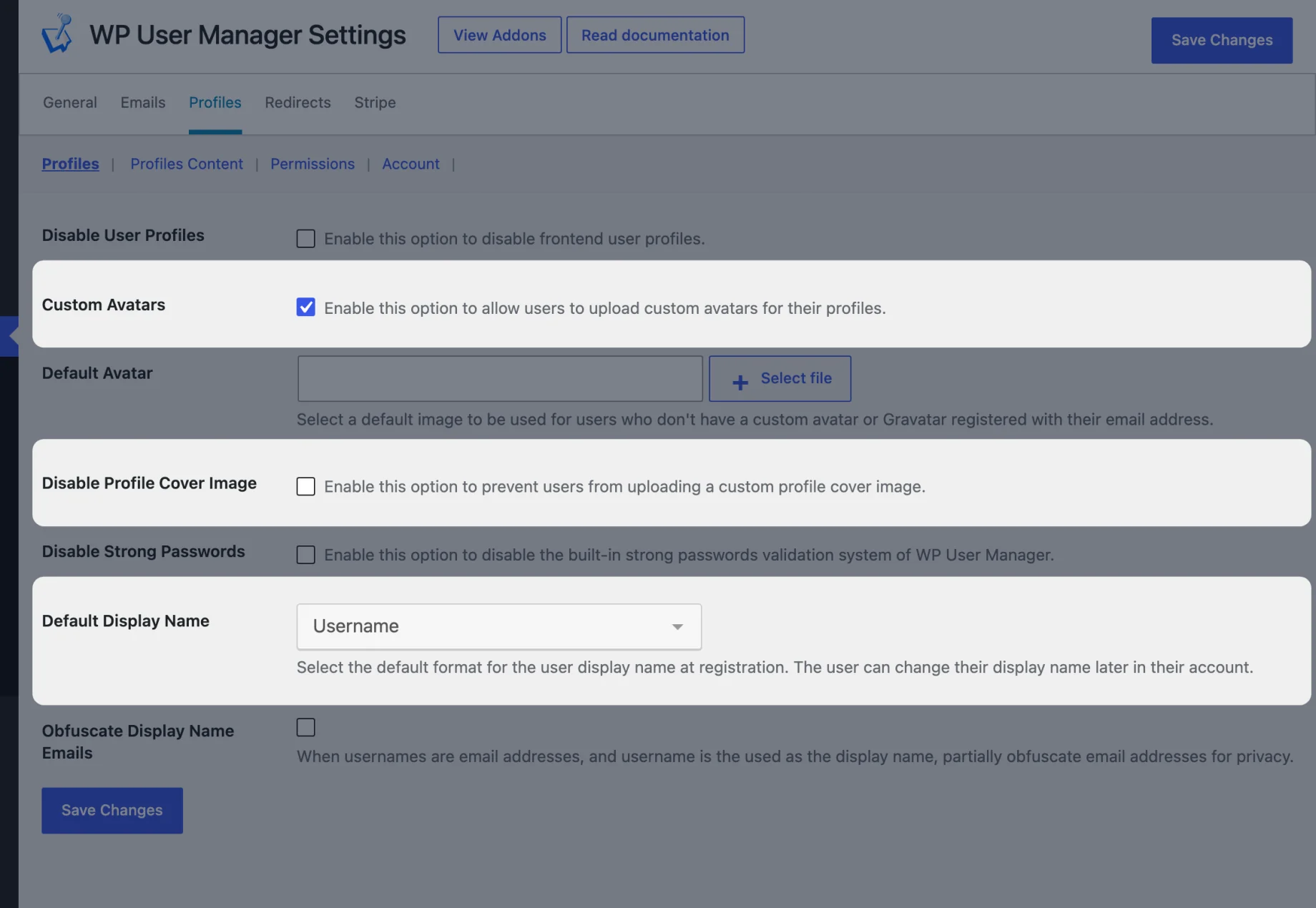
- Choose what profiles show. Go to Users > Settings > Profiles. Turn on Custom Avatars so members can upload a photo, decide whether they can upload a cover image, and pick the Default Display Name. Under Profiles Content, choose whether to show the Posts and Comments tabs. The profiles settings article explains each option.
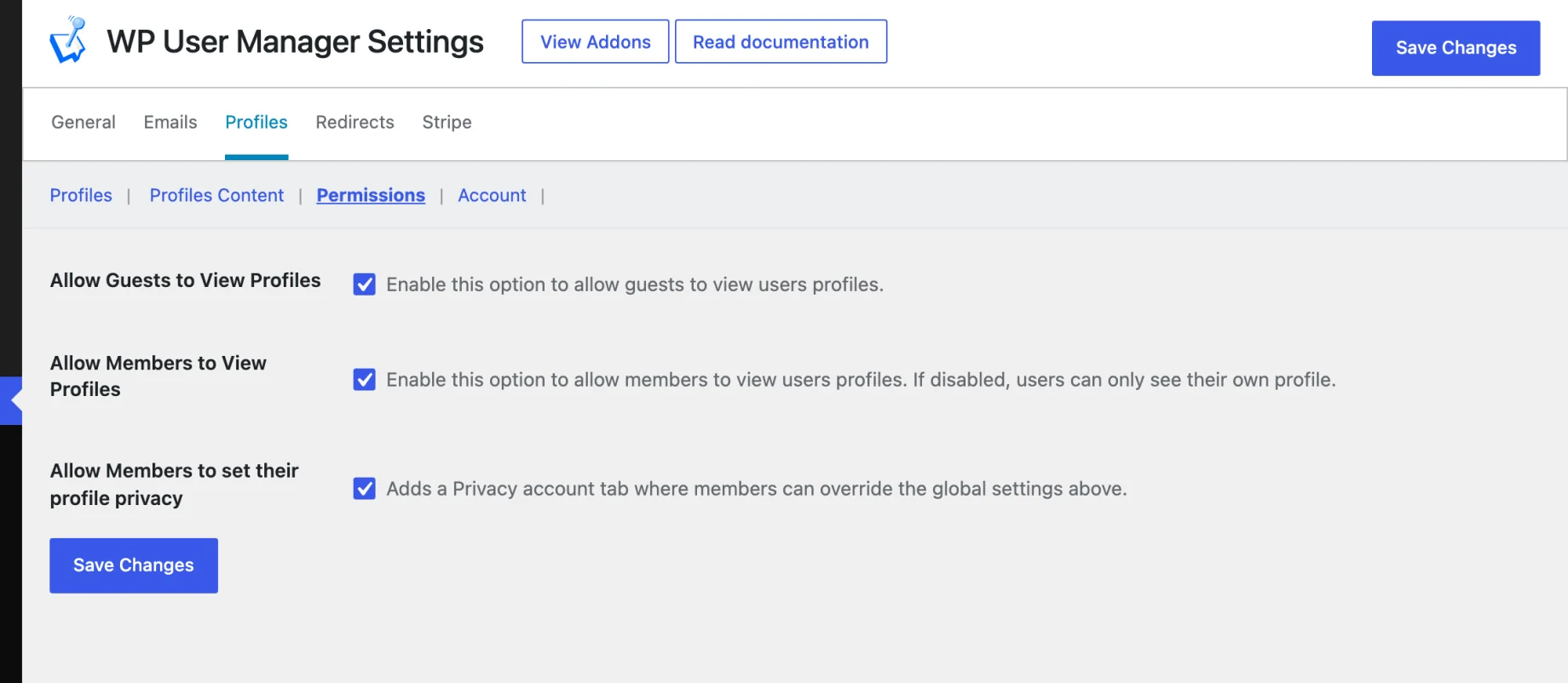
- Set who can see profiles. Under Permissions, choose whether guests and members can view profiles. Allow Members to set their profile privacy adds a Privacy tab to the account page, so a member can override your setting for their own profile. Our help article on controlling profile privacy covers the combinations. Each field also has its own profile visibility, so you can keep something like the email address off public profiles: see how to hide fields on the profile page.
- Add a member directory. Go to Users > Directories, add a directory, choose which roles to list and turn on the search form, then put its shortcode on a page. Our help article on creating a user directory walks through every setting.
- Add your own fields (optional). With the Custom Fields addon, add fields under Users > Custom Fields, then add them to your registration form so members fill them in when they sign up. See how to add custom fields.
Which WordPress user profile plugin should you choose?
- Clean profiles, a directory and registration, kept light: WP User Manager or UsersWP. UsersWP if you design everything in a page builder.
- The most features and extensions, social features included: Ultimate Member.
- Charging for membership is the main job: ProfilePress or User Registration & Membership.
- Distinct member types, each with their own fields: ProfileGrid.
- Forms first, with a paid directory later: Profile Builder.
- A full social network: BuddyPress, on its own or alongside a profile plugin.
To try ours, install the free WP User Manager plugin: profiles, avatars, privacy settings and directories all work without paying anything. When you need custom fields or other addons, see pricing.